Independent guide · read from Maya's own help centre
Maya casino games: the half of it that is switched off
Almost every page about Maya casino games tells you to open the app and deposit. Maya's own help centre says something narrower, and it has said it since 19 December 2025: you can buy and sell crypto in the app, but Send and Receive are unavailable. This page is what is left once that sentence is taken seriously.
Type maya casino game into a Philippine search box and you get a page that looks the same on every site: a grid of operator logos, a green tick beside the word Maya, a button. What none of those pages do is open Maya's own help centre and read it.
So here is the sentence they skipped. It sits in an article called What's new with the refreshed Maya Crypto?, and the date printed under it is 19 December 2025:
You can still buy and sell crypto, and your past purchases are safe. Send and Receive remain unavailable.
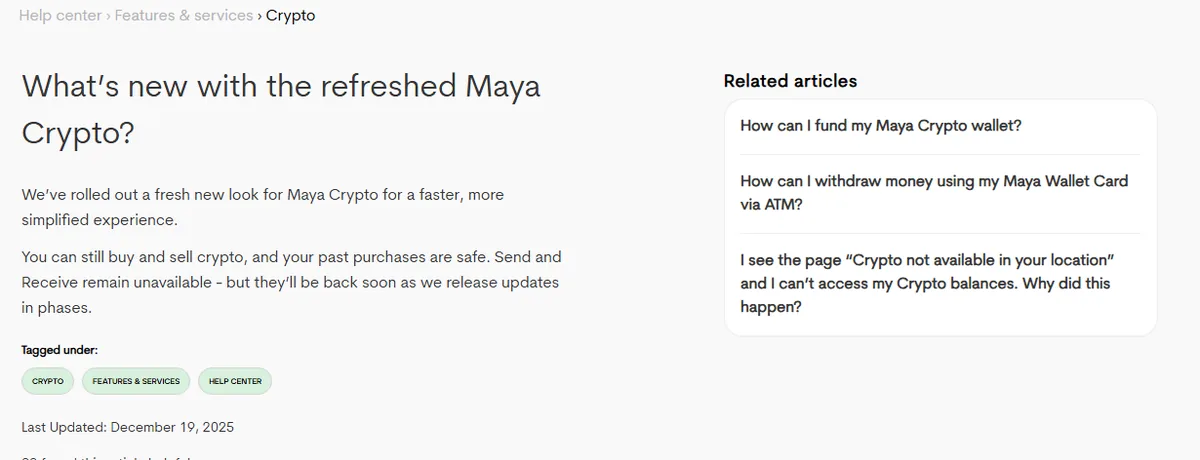
Read the last line before the tags, then read the date under them. Every instruction elsewhere on the internet that tells you to send USDT out of Maya is older than this notice. Screenshot, 24 September 2026
That one line decides most of what follows. It does not stop you funding a casino from a Maya wallet — pesos still move. It stops one specific, widely recommended route dead, and that route is the one an awful lot of Maya casino games pages quietly assume.
Three different people type the same words
The phrase is doing triple duty, and the three groups want opposite answers.
The wallet crowd. Most of the volume. Somebody has ₱500 in the Maya app and wants to know which casino games that money reaches. They are not asking about blockchains; they are asking whether the cash-in button at the other end will accept their wallet.
The in-app crowd. Smaller, newer, and growing. Some Philippine operators have been wiring their lobbies into the Maya app itself, so that the maya casino game is literally a tile inside the wallet rather than a separate site. These people are asking what is in that tile.
The temple crowd. Everyone looking for a slot with a Mayan pyramid on the reels. Different word, different civilisation, same spelling. Around a thousand searches a month in the Philippines go to slot mayan and its relatives, and they land on wallet pages by accident. If that is you, the Maya slots page sorts the two apart in a paragraph.
The rest of this page is written for the first two.
What Maya is, in one paragraph
Maya is a Philippine e-wallet and digital bank, the app that carried the name PayMaya until 2022. Its two companies — Maya Philippines Inc. and Maya Bank Inc. — are regulated by the Bangko Sentral ng Pilipinas, which Maya prints in the header of every page of its own support site, and deposits on the bank side are insured by PDIC up to ₱1 million per depositor. Inside one app there is a wallet, a savings account, a card, and a separate crypto wallet. That last one is not the same thing as the wallet, and confusing the two is the most common reason a transfer people expected to work did not.
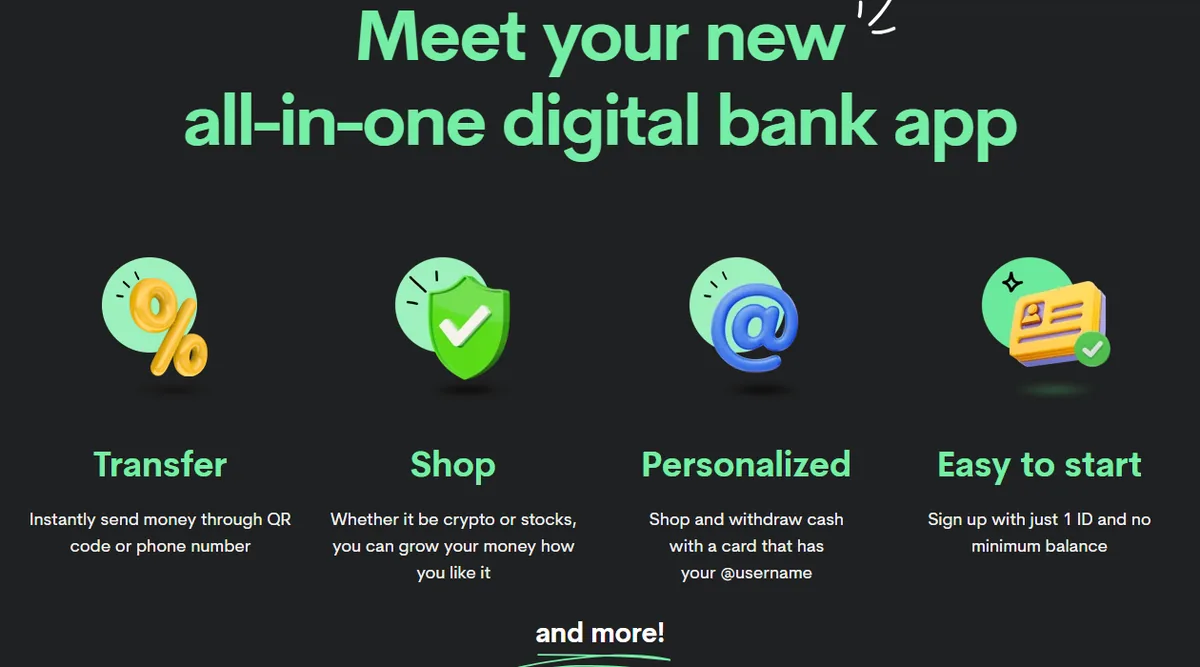
Four promises on the front page, and the first two are the ones this site keeps returning to: instant transfer, and crypto. Both are true of pesos. Only one of them is currently true of a coin. Screenshot, 24 September 2026
The part that still works
Money leaves a Maya wallet in ordinary pesos perfectly well. Bank transfers, InstaPay, QR Ph, the linked card, biller payments — none of that has anything to do with the crypto notice above. If the operator you are funding is a Philippine site that lists Maya among its cash-in options, the maya casino game you are after is reachable in the normal way, and the steps are on the depositing page.
Two things decide whether that works, and neither is under your control:
- Whether the operator has the wallet switched on. Acceptance is a merchant
setting. It is added and removed without announcements.
- Whether the transaction passes the code check. Payments that a card
network or a wallet classifies as gambling can be declined at the rail rather than by the operator, and the message you see will not say so.
That second one is why a deposit can fail at an operator whose page still shows the Maya logo, and why the failure looks like your fault. It is not, and it is not fixed by trying again.
Where the coin can go- USDTone transfer, no peso rail
- No merchant codenothing to be declined
- 21+gambling is a cost, not income
The part that is switched off
Maya Crypto is a genuinely good on-ramp and a dead end at the same time.
What it does: you can buy and sell 24 cryptocurrencies in the app — Maya's list names BTC, ETH, SOL, USDC, DOGE, AVAX, MATIC, LINK, ADA, SHIB, LTC, FIL, DOT, ATOM, APE, UNI, XLM, SAND, ALGO, AXS, MANA, CRO, QNT and USDT — from ₱1 worth upward, and the crypto page states there are no transaction fees on the buy. For somebody in the Philippines who wants to own a little USDT without opening an exchange account, that is about as low as the barrier gets.
What it does not do: let the coin leave. Send and Receive are off. You can buy USDT in Maya and you can sell it back into pesos in Maya, and between those two points it stays where it is.
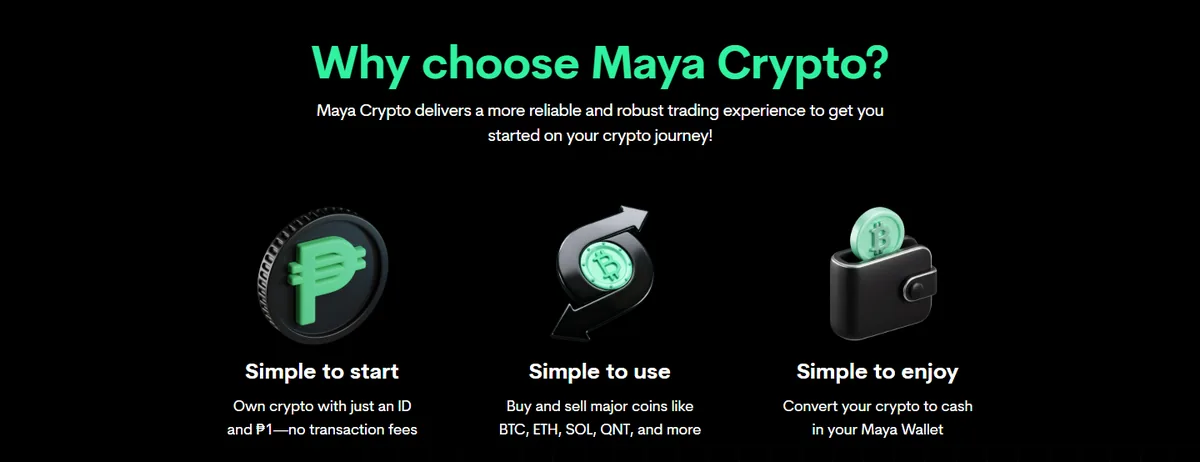
Three claims, all accurate. The third one is the product’s whole shape: converting back to pesos inside the app is the exit, and it is the only exit. Screenshot, 24 September 2026
This matters for maya casino games because the route that every crypto-casino guide recommends to Filipinos is buy USDT in your wallet, send it to the casino. The first half is true in Maya. The second half currently is not.
Worth saying plainly, because it is the kind of thing that changes: Maya's own wording is “remain unavailable — but they'll be back soon as we release updates in phases”. The feature is paused, not abolished. The date under the notice is what tells you how long “soon” has been running, and on the day this page was last checked that was nine months.
A contradiction inside their own help centre
While Send and Receive are described as unavailable, the same help centre still publishes step-by-step guides for sending crypto to Maya from PDAX, from Coins.ph and from Trust Wallet, and an article on generating a QR code to receive crypto. Those pages were not taken down when the feature was paused.
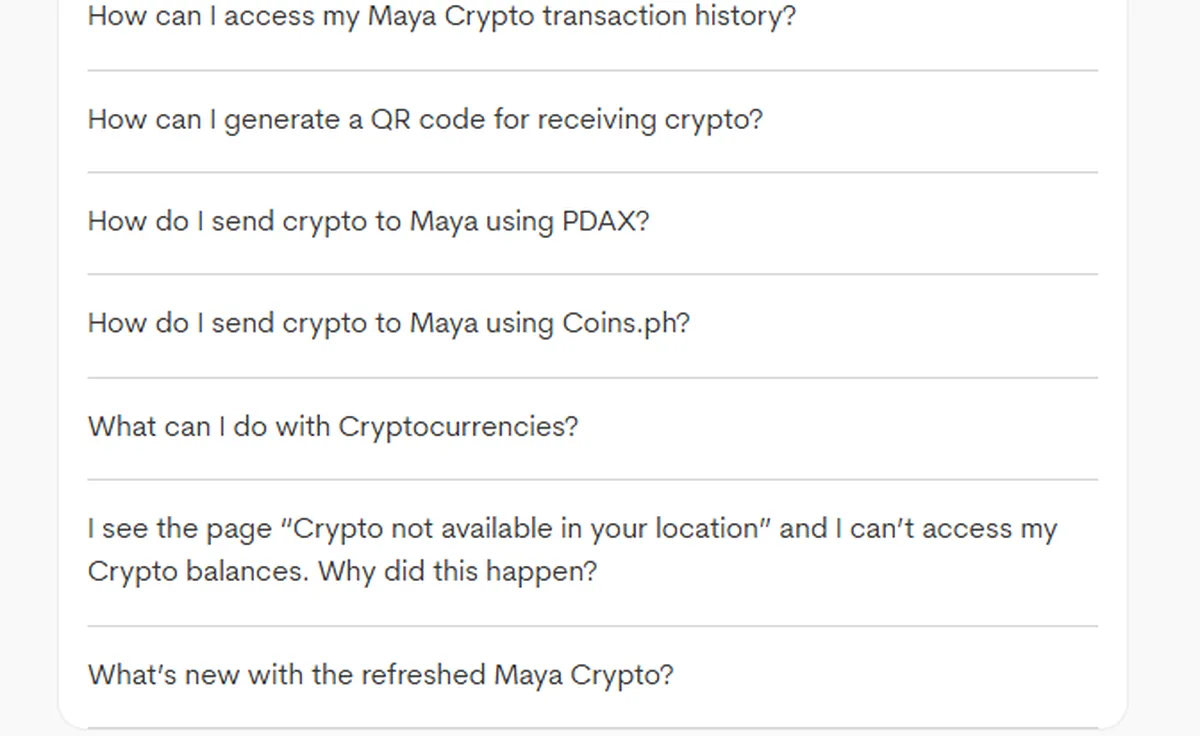
Nobody pulled the sending guides when sending was paused. Follow one, watch nothing arrive, and the natural conclusion is that you scanned the wrong code. Compare the dates, not the instructions. Screenshot, 24 September 2026
This is worth knowing before you try. An article existing is not the same as a feature working, and the newest date wins. If you follow the Trust Wallet guide and the transfer does not arrive, the guide is not lying to you — it is simply older than the notice.
So what actually reaches a crypto casino
If the game you want is at a Philippine operator that takes the wallet, none of this applies and you should stop reading here. If the game you want is at a crypto casino, the peso has to change hands somewhere that allows sending, and Maya is not currently that place.
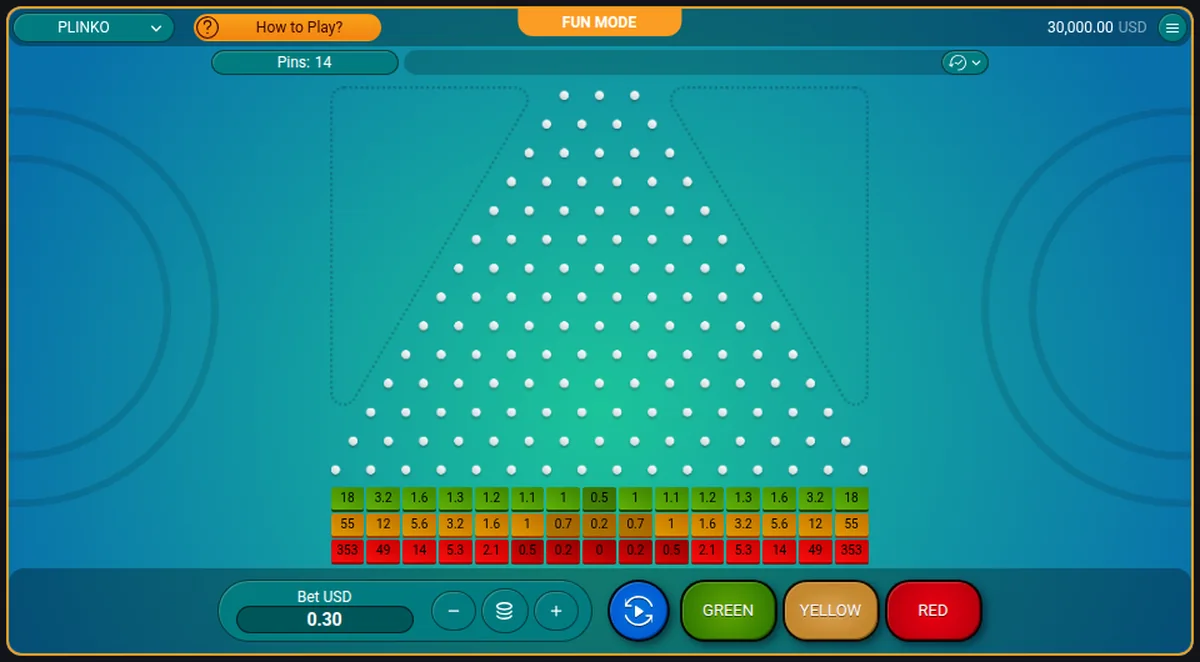
The ball falls through the pegs into a bucket. The big multipliers sit at the outer edges, which are the buckets it reaches least often — that is the whole maths of the game in one picture. Screenshot of the provider's free demo, 24 September 2026
The honest shape of the route is three steps, not two:
- Pesos out of Maya by the ordinary rails — a transfer to an exchange
account in your own name.
- Buy the coin at a venue that allows withdrawals. Maya's own help pages
name PDAX and Coins.ph as platforms that can send crypto to Maya, which is a roundabout way of saying both of them can send crypto out.
- One transfer to the casino address. Right network, right coin, small test
amount first.
The full version, including what a wrong network costs and why the test transfer is not paranoia, is on the USDT route page. It is the only page on this site that is about something other than Maya, and it exists because the Maya answer ran out.
What it costs
Three different numbers get called “the fee” and only one of them is printed.
The crypto buy. Maya's crypto page says no transaction fees, minimum ₱1. Take that at face value for the fee line and not for the total cost: a spread between the shown price and the market price does the same job as a fee and is not disclosed as one. Compare the peso amount you paid against the coin's mid-market price at that moment if you want the real figure.
The peso rails. Cash-in and cash-out charges depend on the channel and on your verification tier, and they are shown in the app before you confirm. This site does not print a table of them, because a table of numbers nobody here has re-checked this week is worse than no table. What it does instead is tell you where to look, on the fees and limits page.
The operator's own cut. Separate again, and the one most people forget when they add up what a maya casino game session cost them.
Maya or GCash
The two wallets are asked about together constantly, and for casino money they are not interchangeable. GCash carries far more search volume for casino questions in the Philippines — around 22,000 a month for gcash casino against roughly 4,400 for maya casino game — which mostly tells you which wallet merchants integrated first, not which one works better.
The differences that actually bite are the crypto side, the merchant coverage and the decline behaviour. They are laid out side by side on Maya vs GCash.
The games themselves
Once the money question is settled the game question is small, and it is mostly about who built what. The Philippine market runs heavily on a handful of studios whose names appear on almost every lobby, and the tiles inside an in-app maya casino game section are usually drawn from the same shelf as the tiles on the website. Which titles those are, and what changes when a lobby is embedded in a wallet rather than opened in a browser, is on the games.
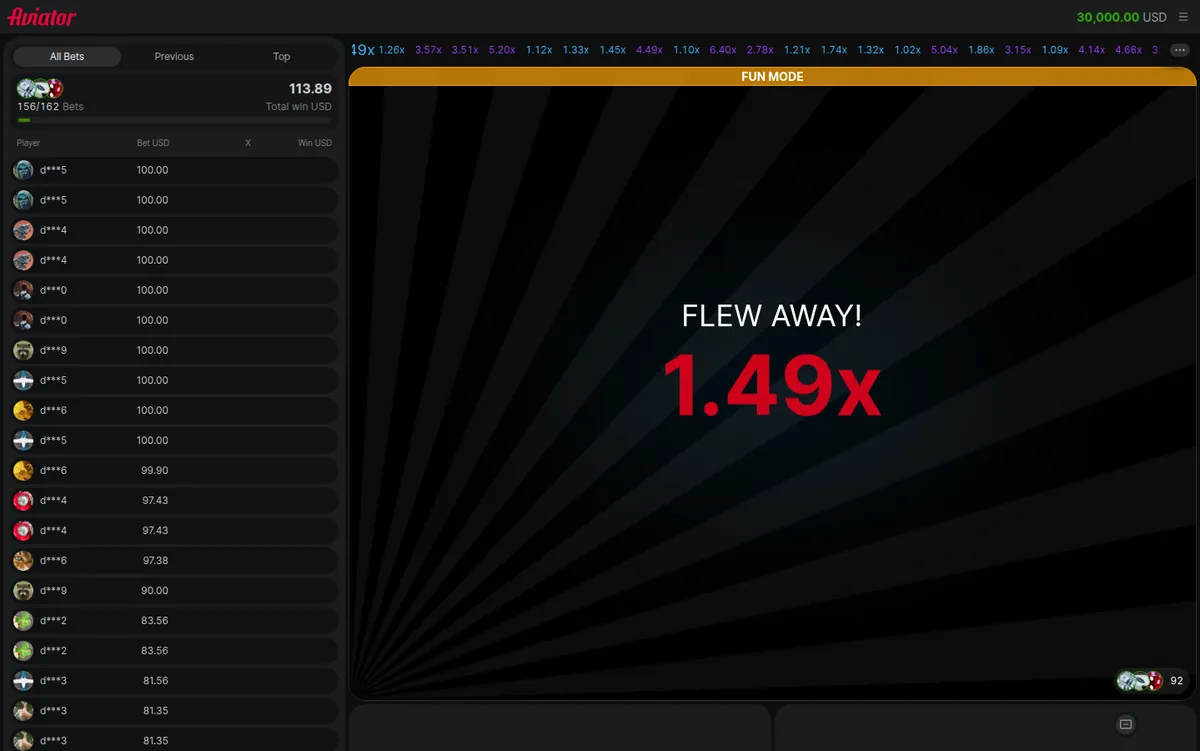
A crash game in the provider's own demo, captured here rather than borrowed. The multiplier climbs and stops at a moment nobody in the room knows in advance — the whole game is deciding when to take the money. Screenshot of the provider's free demo, 24 September 2026
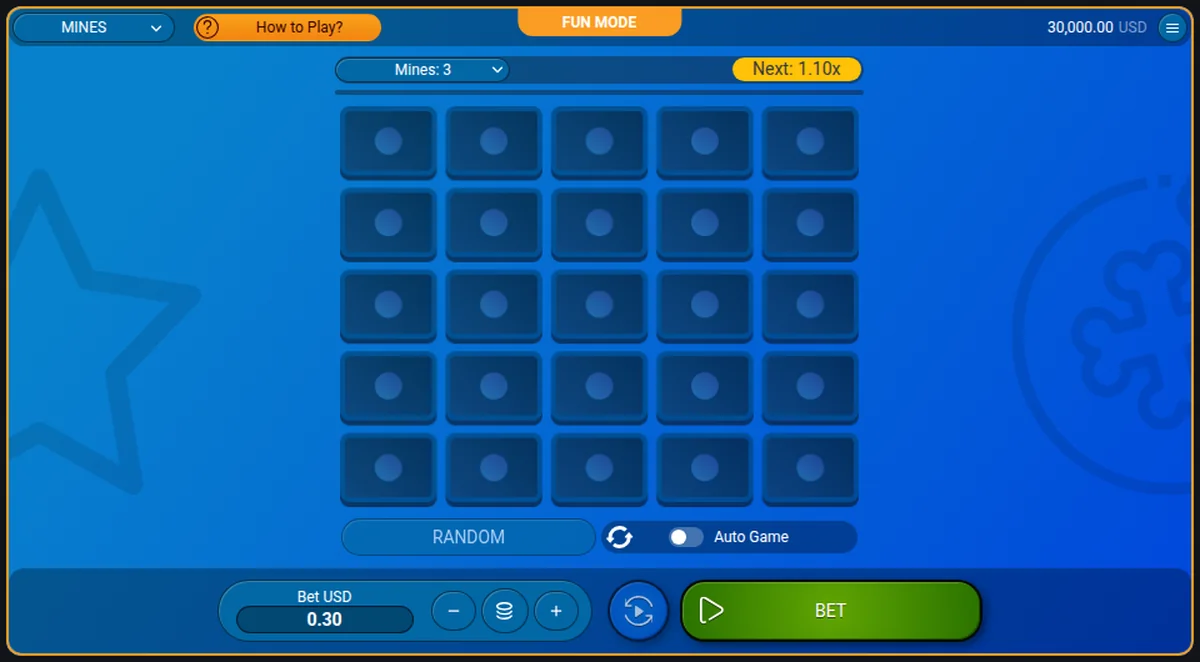
Pick tiles, avoid the mines, cash out before one turns up. The payout rises with every safe tile, which is exactly what makes the last one tempting. Screenshot of the provider's free demo, 24 September 2026
Getting money back
Cashing out to a Maya wallet has one rule that catches people out: the name on the casino account and the name on the wallet have to match, and an operator that let you deposit under a mismatched name will still refuse to pay one out. The check happens on the way out, not on the way in, which is the worst possible order for the person it happens to. What to do before that point rather than after is on cashing out.
One more thing belongs here, because it is the question people ask after the first successful withdrawal rather than before it: the wallet you cash out to should be the same wallet you deposited from. Some operators enforce that as a rule and some only enforce the name, but returning money by the route it arrived on is the version of the story that needs no explaining to anybody, and an explanation is exactly what a review team asks for when the two differ.
What this site will not tell you
- How fast anything pays. Nobody here has timed a withdrawal, so there is no
“instant” on this site, in those words or any others.
- Which operator is best. There is no ranking here and no score. Which
cashier takes which wallet changes weekly and silently, so a list of it is stale before it is read.
- How to get around a block. If a payment is refused, this site tells you
what refused it. It does not tell you how to make it not refuse.
- Anything about the law. Not the site's subject and not its competence.
What a refused deposit actually looks like
The single most useful thing to know about maya casino games is how a failure presents itself, because it almost never presents itself as what it is.
The generic decline. “Transaction cannot be completed at this time.” No code, no reason, no difference between a wallet that is out of balance, an operator that turned the method off last week and a rail that classified the payment and stopped it. The same nine words cover all three. Trying again produces the same nine words, and on some rails a repeated attempt is itself a signal that makes the next one likelier to fail.
The silent partial. The pesos leave the wallet, the operator's balance does not move, and the app shows the transaction as successful because from the wallet's point of view it was: the money reached the payment processor. It is sitting with the processor, and it will come back in anything from hours to a fortnight. This is the failure that generates the angriest support tickets and the one where the support ticket is genuinely the right move — but at the processor's customer, which is the operator, not at Maya.
The name mismatch. Everything works, the maya casino game loads, the balance is there, and the problem surfaces weeks later at the first withdrawal, when the name on the wallet and the name on the account turn out to differ by a middle initial. Nothing about the deposit warned anybody. The check lives on the way out.
The tier ceiling. A wallet in a lower verification tier has lower caps than the same wallet fully verified, and the cap is monthly as well as per transaction. A deposit that worked on the 3rd and fails on the 27th with no change at either end is usually this, and the app will show you the remaining allowance if you look before you assume the operator broke something.
Four different causes, one message. What separates them is the order you check them in, which is: the app's own transaction list first, the operator's cashier history second, the wallet's remaining monthly allowance third, and only then support. Most people do that in reverse and lose a day.
The in-app lobby is a different product
The newer meaning of maya casino game — a lobby that lives inside the wallet rather than in a browser — deserves separating out, because the economics of it are different from a website that merely accepts the wallet.
When an operator is embedded in a payment app, three things change at once. The funding step disappears, because the balance is already there; that is the whole selling point and it is a real one. The operator's game catalogue usually shrinks, because an embedded lobby is a smaller surface than a full site and the studios have to agree separately to appear in it. And the session becomes visible to the wallet in a way a browser session is not: the app knows what you spent, when, and how often, in the same list as your groceries.
That last point is worth a sentence of its own, because it cuts both ways. A gambling spend that sits in the same transaction history as everything else is easier to hide from yourself if you do not look, and impossible to hide from yourself if you do. Anyone who has ever told themselves they were up for the month can settle the question in about twenty seconds by scrolling. Most of the tools that help are on the safer play page, and the cheapest of them is that scroll.
What an embedded maya casino game cannot do is change the withdrawal rules. The money still leaves under the operator's terms, on the operator's schedule, with the operator's identity checks. Convenience at the front door is not speed at the back one, and no amount of integration makes it so.
The three routes, side by side
Everything above reduces to three ways money gets from a Maya wallet to a game, and it is worth seeing them next to each other, because the middle one is the one the search results assume and the bottom one is the one they skip.
| Route | Where the money changes hands | What stops it |
|---|---|---|
| In-app lobby | Nowhere — the balance is already inside the app | The operator has to be embedded; catalogue is smaller |
| Peso cash-in to a PH operator | At the operator's cashier, in pesos | Merchant setting switched off, rail-level decline, tier cap |
| Crypto casino | At an exchange, outside Maya | Maya's Send is unavailable, so Maya cannot be that exchange |
Read the right-hand column as the real content of the table. The first route fails for a reason you cannot fix, the second fails for four reasons you can at least tell apart, and the third does not fail so much as not exist in the form everyone describes it. That is the whole map for maya casino games in 2026, and the rest of this site is the detail behind each row.
What the pages above this one leave out
It is worth being specific about the gap, because the gap is the only reason to read a new site instead of an old one.
The results for maya casino game in the Philippines are, almost without exception, a payments subfolder on a large multi-country affiliate site: a /payments/maya/ here, a /deposit-methods/paymaya/ there. Those pages are competently made. They are also written from a template that has been filled in for forty payment methods across thirty countries, and a template has no way of knowing that one of the forty had a feature switched off last December.
So they all say the same four things: Maya is fast, Maya is popular in the Philippines, here are casinos that take it, here is how to deposit. Every one of those is defensible. None of them is checkable, because none of them carries a date or a source, and two of them stop being true the moment a merchant setting changes.
What is missing from all of them is the sentence this page opened with. A reader who follows the standard advice — open Maya, buy USDT, send it to the crypto casino — gets as far as step two and then finds a screen that does not have the button the guide described. Nothing on the guide prepares them for it, and the natural conclusion is that they did something wrong.
The second thing missing is failure. A maya casino game page that only describes the happy path is useless on the day you need it, because nobody searches for a payment method while the payment is working. The four decline shapes above took longer to write than the deposit steps did, and they are the part likelier to save somebody an afternoon.
The third is arithmetic. “No transaction fees” is printed by Maya and repeated everywhere, and it is true about the fee line. Whether a purchase actually cost nothing is a different question that requires comparing the peso figure you paid against the market price at that minute, and no page that repeats the phrase ever suggests doing it.
None of this makes the other pages dishonest. It makes them general, in a subject where the useful part is specific and dated. This site is narrower on purpose: one wallet, one country, every number carrying the day it was read.
How to check any of this yourself
Every number and every quotation on this site can be checked without trusting the site, and the method is short enough to print.
Find the help article, not the marketing page. Maya's marketing pages describe what the product is for; the help centre describes what it currently does, and when the two disagree the help centre is the one that has been updated. The crypto articles sit under a single topic page in the support site, and each one prints a “Last Updated” date at the bottom. That date is the most valuable element on the page.
Read the date before the text. An article about a paused feature and an article explaining how to use that feature can both be live at the same time, because nobody deleted the second one. Whichever carries the newer date is the one describing today.
Check the app against the article. The final authority is neither the help centre nor this site: it is whether the button is there when you open the app. A feature that is described as available and is not in your app is usually a staged rollout, and a feature that is described as unavailable and is in your app means the article is stale in your favour.
Write down what you saw and when. Every claim on this site carries the date it was read, for exactly this reason. A payments page without dates is a page that cannot be wrong, because it never said when it was true.
Where to go next
If you are trying to fund an account today, start at depositing. If you already tried and something bounced, fees and limits and Maya Crypto cover the two usual reasons. If you got here looking for a temple on the reels, Maya slots is the page you wanted.
And if the amount you are about to move is larger than the amount you decided to move before you opened the app, the page worth reading first is safer play. Who writes all this, and how it is paid for, is in who writes this.